
A family in a Jumeirah villa discovered their electrical panel was overloaded at 11:45 PM on a Thursday. Their daughter had just switched on the bedroom AC. The main breaker tripped. Lights out. No problem, right? Just reset it.
Except the breaker wouldn’t stay on. It kept tripping every 30 seconds. The husband, an engineer by profession, opened the panel himself. What he found made him close it immediately and step back. Melted wire insulation. Burn marks around three circuit breakers. The faint, unmistakable smell of something that had been overheating for months, possibly years.
The electrician who arrived the next morning told him something that stayed with me when he repeated it: “Another week and you might have had a fire.”
That villa had been maintained by the same building management company for six years. Annual inspections. Ticked boxes. Nobody had actually looked inside that panel properly in years.
Here’s the uncomfortable truth about electrical safety in UAE homes: most residents are one overloaded circuit, one ignored warning sign, or one unqualified technician away from a serious incident. Dubai’s rapid construction, extreme climate conditions, and the sheer density of electrical load in modern homes create a specific set of risks that generic electrical safety advice doesn’t adequately address.
This guide covers everything that matters. Not the obvious stuff you already know, but the specific, actionable knowledge that actually prevents fires, protects families, and keeps your home compliant with DEWA standards and UAE electrical regulations.
You’ll discover:
- Why Dubai’s climate creates unique electrical risks that other countries don’t face
- The five warning signs most residents ignore until it’s too late
- Exactly which electrical work requires DEWA-approved contractors (and what happens when you skip this)
- Real cost breakdowns for electrical safety upgrades in 2025
- How to evaluate whether your current electrical system is safe
- The specific questions that reveal whether an electrician actually knows UAE standards
I’ve worked with dozens of villas and apartments across Dubai over the past several years. I’ve seen the aftermath of electrical failures. I’ve also seen properties where proactive safety measures prevented disasters. The difference almost always comes down to awareness and action taken before the crisis.
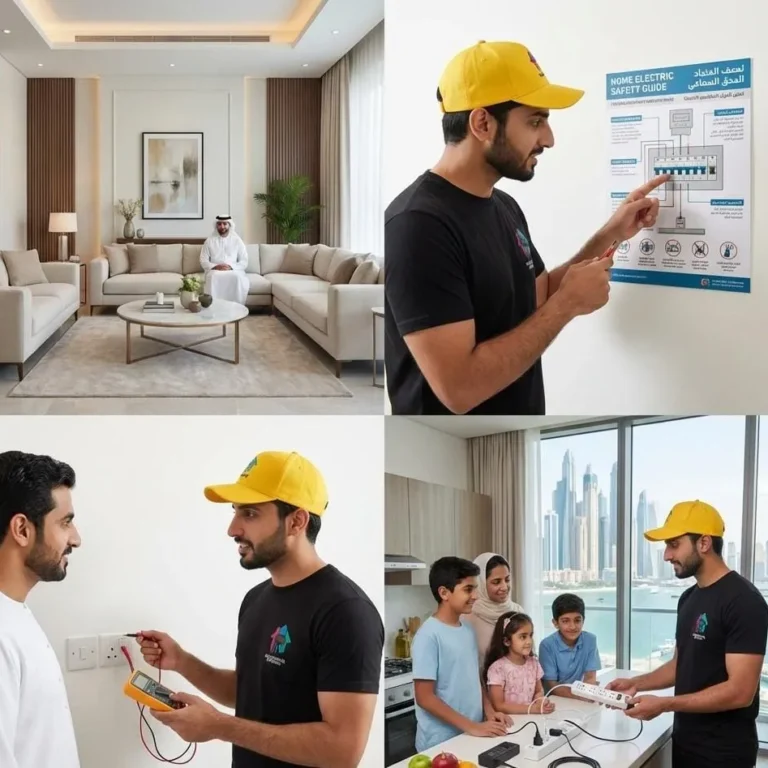
Why Dubai’s Climate Makes Electrical Safety More Critical Than Anywhere Else
Dubai’s combination of extreme heat, high humidity, and heavy electrical load creates electrical stress conditions unlike any temperate climate. Most electrical failures here aren’t random—they’re predictable consequences of insufficient design for local conditions.
Let me explain what actually happens inside your walls during a Dubai summer.
Ambient temperatures in roof spaces and wall cavities regularly reach 65-75 degrees Celsius during July and August. Standard electrical cable insulation is rated for continuous operation at 70 degrees Celsius in many older installations. When your wall cavity temperature approaches that rating, the insulation begins degrading. Not immediately. Not visibly. But continuously and cumulatively, every summer, year after year.
Now add the load factor. A typical three-bedroom villa in Emirates Hills or Al Barsha runs:
- 4-6 AC units (each drawing 1.5-3.5 kilowatts)
- Water heater (3-4.5 kilowatts)
- Kitchen appliances (dishwasher, refrigerator, microwave simultaneously: 4-6 kilowatts)
- Entertainment systems, washing machines, dryers
- Pool pumps in villa properties (0.75-2.2 kilowatts)
Total continuous load regularly hits 15-25 kilowatts in a large villa during summer evenings. Many older villas were designed for 10-15 kilowatt loads when built in the 1990s and early 2000s. The electrical infrastructure hasn’t kept pace with how we actually live now.
The humidity factor is equally serious but less discussed.
In coastal areas and during the humid season (August-September), relative humidity inside wall cavities can reach 80-90%. This creates condensation on electrical connections, accelerates corrosion of copper terminals, and degrades the performance of circuit breakers and safety devices. A breaker that tested perfectly fine in February might fail to trip correctly by September.
I watched an electrician test a circuit breaker panel in a Marina apartment last year. Eight of the twelve breakers showed signs of corrosion on their terminals. The apartment was only four years old. The owner had no idea. The technician showed him photos before and after cleaning and treating the connections. The difference was shocking.
The rapid construction reality.
Dubai built an enormous amount of housing between 2003-2008 and again between 2013-2019. Construction pace during boom periods sometimes outpaced quality control. I’ve personally seen electrical installations in “new” buildings that used undersized cable, poor quality junction boxes, and terminal connections that hadn’t been properly torqued. These issues don’t manifest immediately. They develop over 5-10 years as connections loosen from thermal expansion and contraction cycles.
This isn’t a criticism of Dubai construction broadly. It’s a recognition that rapid growth creates statistical quality variation, and electrical systems in your property deserve independent verification rather than assumed safety.
The Five Warning Signs Most Dubai Residents Ignore
These warning signs appear before serious electrical failures. Recognizing them early—and acting on them—is the difference between a AED 500 preventive repair and a AED 50,000 fire damage claim.
Warning Sign 1: Breakers That Trip Regularly
Here’s what most people do when a breaker trips: reset it and forget it. If it happens again, reset it again. By the third time, some people start calling it “the kitchen breaker” and just accept it as a quirk.
This is dangerous thinking.
A breaker that trips regularly is telling you something specific: either the circuit is consistently overloaded, or the breaker itself is failing. Both conditions require investigation, not tolerance.
The distinction matters:
- Overloaded circuit: The actual electrical load exceeds what the circuit was designed for. Solution: Either redistribute loads to other circuits or upgrade the circuit capacity with a DEWA-approved electrician.
- Failing breaker: The breaker’s thermal or magnetic trip mechanism is degrading. It might trip too easily (nuisance tripping) or, more dangerously, might start failing to trip when it should. A breaker that doesn’t trip during an actual overload is worse than no protection at all.
Real case: A tenant in JVC called me about a “finicky” breaker that had been tripping monthly for two years. Building management kept resetting it and saying the system was fine. When a qualified electrician finally opened the panel, the breaker showed significant internal burning. The circuit it protected had been running at 90% of rated capacity for years. The breaker had been failing incrementally. The tenant had been one bad day away from a fire for months.
Cost to replace that breaker: AED 180. Cost if it had failed into a fire: insurance claim, displacement, potential liability. Unquantifiable.
Warning Sign 2: Burning Smell Near Outlets or Switches
The smell of burning plastic or an acrid, metallic odor near any electrical fixture is an emergency. Not “I should call someone this week.” Call someone today. Turn off that circuit at the breaker immediately.
This smell indicates one of three things:
- Overheating wiring due to overload or undersized cable
- Loose connection creating resistance and heat
- Faulty device with internal failure
All three require immediate professional assessment. None get better on their own.
I’ve noticed that many residents dismiss this smell, particularly if it’s intermittent. “It was there last night but it’s gone now.” The intermittent nature doesn’t mean the problem resolved. It likely means the connection is heating, cooling, and heating again in cycles—which is exactly how electrical fires start.
Warning Sign 3: Lights Flickering or Dimming When Appliances Start
Slight dimming when a large appliance starts (like an AC compressor) is normal—motors draw high startup current momentarily. But persistent flickering, dimming that lasts more than a second or two, or flickering that occurs randomly without obvious cause indicates loose wiring connections somewhere in the circuit.
Loose connections create resistance. Resistance creates heat. Heat creates fire risk.
In older Dubai properties, this is often caused by terminal connections that have loosened over multiple thermal expansion cycles (summer heat followed by winter cooling, repeated over years). The connections were fine originally. They’ve worked loose gradually.
The fix is usually straightforward: A qualified electrician checks all connection points in the affected circuit, re-torques loose terminals, and replaces any damaged components. Cost: AED 200-500 typically for a single circuit investigation and repair.
What not to do: Don’t assume it’s the bulb. Don’t replace the switch yourself. Don’t ignore it.
Warning Sign 4: Outlets or Switches That Feel Warm or Hot
Every outlet and switch in your home should be at or near ambient temperature. If touching a switch plate or outlet cover feels noticeably warm, something is wrong.
Warm outlets indicate:
- Overloaded circuit with insufficient wire capacity
- Loose connection creating resistance
- Faulty outlet with internal damage
- Wire gauge mismatch (wrong wire size for the circuit’s ampere rating)
Hot outlets—where the cover plate is uncomfortable to touch—indicate an active problem requiring immediate action. Switch off whatever’s connected to that outlet, turn off the circuit at the breaker, and call a licensed electrician the same day.
This is more common in older properties where the original electrical installation used the minimum acceptable wire gauge, and load has increased over the years as residents added more appliances.
Warning Sign 5: Frequent Bulb Burnouts
If bulbs in a particular fixture or area burn out significantly faster than expected, it usually indicates voltage fluctuation or slight overvoltage in that circuit. Standard UAE voltage is 220-240V. Consistent voltage above 250V significantly reduces bulb and appliance life.
This matters for two reasons. First, it’s costing you money in replacement bulbs. Second, chronic overvoltage stresses all appliances and equipment on that circuit, shortening their life and increasing failure risk.
The solution: A qualified electrician measures actual voltage at the affected outlets over time, checks the main supply from DEWA, and investigates whether the issue is in the building’s distribution or in the unit’s internal wiring.
Cost to diagnose: AED 150-300. Cost to ignore: Premature failure of appliances worth thousands, plus potential fire risk.
Understanding DEWA Electrical Regulations: What’s Actually Required
In Dubai, the Dubai Electricity and Water Authority sets and enforces electrical safety standards through the UAE Electrical Wiring Regulations (EWR). Understanding what’s required—and what happens when you ignore it—is essential for every property owner.
Here’s what most people don’t know: DEWA requires that any new electrical installation, modification, or significant repair be carried out by a DEWA-approved contractor and inspected before energization. This isn’t optional. It’s not a guideline. It’s a legal requirement.
What requires DEWA-approved contractors:
- New electrical installations (complete unit wiring)
- Adding new circuits or modifying existing circuit capacity
- Upgrading electrical panels or main distribution boards
- Installing new air conditioning connections
- Any work involving the main supply connection
What typically doesn’t require DEWA approval (but still requires licensed electricians):
- Replacing like-for-like outlets and switches
- Fixing existing wiring faults within the same capacity
- Replacing circuit breakers with identical rated units
The real-world implication: If you hire an unlicensed “handyman” to add a new circuit for your home office, you’ve created an illegal electrical installation. If that installation later causes a fire or injury, your property insurance may refuse to cover the claim because the work didn’t meet regulatory requirements. This isn’t theoretical—it happens.
Finding DEWA-Approved Contractors
DEWA maintains a register of approved contractors on their website (dewa.gov.ae). You can search by trade and verify that any contractor you hire has current DEWA approval status.
When you get a quote, ask directly: “Are you DEWA-approved for electrical contracting?” A legitimate contractor will immediately say yes and can provide their DEWA approval number. They’ll also mention the inspection process as a normal part of the project.
Red flag: Any electrician who says inspection “isn’t necessary” or “isn’t usually done for small jobs.” DEWA’s requirements don’t have a size exception.
Current cost context for DEWA-compliant electrical work (early 2025):
- New circuit installation (single 20-amp circuit): AED 800-1,500 depending on run length and complexity
- Electrical panel upgrade (upgrade main distribution board): AED 3,500-8,000 depending on capacity and building type
- DEWA inspection fee: Varies by project scope, typically AED 200-500
- Complete villa rewiring: AED 15,000-45,000 depending on villa size and existing condition
These costs reflect DEWA-approved contractors with proper materials. If someone quotes you 40% below these ranges, they’re either using substandard materials, not getting proper inspection, or paying unlicensed labor.
The Specific Electrical Risks in Dubai Villas vs. Apartments
Villas and apartments face different electrical risk profiles. Understanding which applies to your property helps you prioritize.
Villa-Specific Electrical Risks
Older wiring in established communities. Villas in Jumeirah, Mirdif, Al Barsha, and older Sharjah communities were often built 15-25 years ago. Electrical standards have evolved significantly since then. Wire quality has improved. Protection requirements have increased. An older villa may have adequate wiring by standards of the time but fall short of current best practices.
Garden and pool electrical installations. Outdoor electrical in UAE’s climate faces severe stress: UV degradation of cable sheaths, moisture ingress, sand and dust abrasion. Pool pump electrical installations require specific waterproofing and residual current device (RCD) protection. I’ve seen villa pool electrical installations that would horrify any qualified electrician—unprotected connections, wrong cable types, missing RCD protection near water.
Generator connections. Many villas, particularly in areas with older grid infrastructure, have backup generators. Improper generator connection is one of the most dangerous electrical situations possible. If a generator isn’t properly isolated from the grid supply through a transfer switch, it can backfeed electricity onto the grid while DEWA workers are doing maintenance—creating life-threatening hazards for them and potential damage to your equipment when the grid returns.
Proper generator installation (with manual or automatic transfer switch): AED 2,500-6,000 depending on generator capacity. Non-negotiable if you have a generator.
Multiple air conditioning systems. Large villas might run 6-10 AC units simultaneously. This load concentration requires proper circuit design. Each AC unit should have its own dedicated circuit, correct wire gauge for the unit’s ampere draw, and appropriate overcurrent protection. Older villas often have AC circuits that were retrofitted when the original design didn’t anticipate this many units.
Apartment-Specific Electrical Risks
Shared building systems. Your unit connects to building electrical infrastructure you don’t control. The quality of that infrastructure affects your unit’s safety. Problems in the building’s distribution can manifest as voltage fluctuations, earth (ground) issues, or inadequate neutral connections—all of which can damage sensitive electronics or create safety hazards in your unit.
Limited panel access. Apartment main distribution boards are typically inside the unit but sometimes in common areas or locked electrical rooms. Knowing where your main disconnect is and being able to access it quickly in an emergency is essential. I’ve been in emergency situations where residents didn’t know where their main breaker was. Valuable seconds lost.
High-floor issues. In high-rise apartments, the distance from the building’s main supply to upper floors can cause voltage drop. This is normally compensated in good building design, but older or poorly designed buildings may have voltage significantly below the 220V standard at upper floors—causing appliances to work harder, run hotter, and fail earlier.
Shared walls and fire risk transmission. An electrical fire in your neighbor’s unit can spread to yours faster than in standalone villas. This makes working smoke detectors and fire suppression systems critical, not optional.
Essential Electrical Safety Equipment Every Dubai Home Needs
This section is about specific products, honest assessments, and realistic costs. No generic advice.
Residual Current Devices (RCDs)
An RCD detects current leaking from a circuit (which happens when electricity flows through a person or water) and disconnects the circuit within 30-100 milliseconds. It’s the difference between a shock that surprises you and one that kills you.
UAE requirement: RCDs are required in specific locations under UAE electrical wiring regulations: bathroom circuits, kitchen circuits, outdoor circuits, and circuits serving areas near water. Many older properties have RCDs in some locations but not all required locations.
Types:
- Fixed RCD (installed in the distribution board): Protects entire circuits. Best solution for whole-circuit protection. Cost: AED 150-300 per device installed.
- Socket RCD (plug-in device): Convenient for specific outlets. Good for protecting individual high-risk appliances. Cost: AED 80-150 per device.
My strong recommendation: Have a licensed electrician audit your RCD coverage and add devices wherever protection is missing. Budget AED 500-1,200 for a typical apartment, AED 1,000-2,500 for a villa, to achieve comprehensive RCD coverage.
Brand note: Schneider Electric, Legrand, and ABB are the reliable brands in UAE market. Generic Chinese alternatives exist at half the price. Don’t. RCDs protect human lives. This is not where you optimize for cost.
Surge Protection Devices
UAE power supply quality has improved significantly in the past decade, but voltage spikes still occur—during switching operations, lightning events, or grid issues. Modern homes are full of sensitive electronics: smart TVs, laptops, gaming systems, refrigerators with digital controllers, heat pump water heaters. A significant voltage spike can destroy thousands of dirhams worth of equipment in seconds.
Whole-home surge protection (installed at the main distribution board) provides the most comprehensive protection. Cost installed: AED 600-1,500 depending on the device rating and brand.
Point-of-use surge protectors for sensitive equipment clusters (home office, entertainment center). Look for devices with joule ratings above 1,000J and UL listing or equivalent certification. AED 50-200 per unit depending on quality and outlet count.
What I use: A whole-home surge protector at the panel plus point-of-use protection for my most sensitive equipment. The combination covers both large spikes (panel device) and smaller but cumulative micro-surges (point-of-use).
What I avoid: The cheap extension cords with a “surge protection” label sold in supermarkets for AED 15-30. These typically have minimal joule rating and no meaningful surge protection. They’re power strips with false confidence.
Smoke Detectors and Heat Detectors
Building regulations require smoke detectors in new construction, but many older properties either lack them or have non-functional units with dead batteries that nobody has checked in years.
For living areas and bedrooms: Photoelectric smoke detectors respond better to slow, smoldering fires (more common in residential settings). Kidde and Nest Protect are reliable brands available in UAE. Nest Protect (AED 320-380) adds CO detection, mobile alerts, and monthly automatic self-testing—worth the premium for smart home users.
For kitchens: Heat detectors rather than smoke detectors prevent false alarms from cooking. Fixed temperature heat detectors activate at 57-94 degrees Celsius depending on rating.
For UAE specifically: Interconnected detectors (when one alarm sounds, all sound) are worth the additional installation cost in larger villas where a bedroom alarm might not be audible in a distant guest room. Wireless interconnection systems avoid the need for cable runs between units.
Realistic cost for comprehensive detection in a 3BR villa: AED 800-1,500 for devices, plus AED 300-600 for installation and testing.
Test them monthly. Replace batteries annually unless they have 10-year sealed batteries (worth paying for). Replace entire units every 10 years regardless of apparent function.
DIY vs. Professional: What You Can Safely Do Yourself
This is where I’ll be more direct than most guides.
You can safely do yourself:
- Replace a like-for-like bulb (obviously)
- Replace a plug fuse in a UK-style plug (common in UAE)
- Reset a tripped circuit breaker (once, while investigating the cause)
- Test smoke detectors
- Check and replace smoke detector batteries
- Plug in surge protectors to existing outlets
You should not do yourself:
- Any work inside electrical panels or distribution boards
- Replacing or adding outlets and switches
- Any work involving wiring
- Installing new appliances that require dedicated circuits
- Anything involving outdoor electrical
- Any work near water (bathrooms, kitchens, gardens, pools)
Here’s my honest opinion: The “I watched a YouTube video” approach to electrical work is genuinely dangerous in UAE homes. The voltage standard (220-240V vs. 110-120V in North America) is more dangerous—shocks are more likely to be fatal. The heat and humidity degrade the quality of amateur work faster. And the regulatory environment means unlicensed work creates both safety and legal risks.
I’ve watched a well-meaning tenant in JLT install an outdoor outlet by following a YouTube tutorial. He did it technically correctly—right connections, right color coding. But he used standard indoor-rated cable outside in the sun. Within eight months, UV degradation had compromised the cable sheath. The outlet developed an earth fault. Nobody was hurt, but the amateur installation could have electrocuted anyone using that outdoor outlet near the pool.
The cost of doing it properly: An electrician replacing an outlet costs AED 80-150. Doing it yourself saves you this amount while creating legal liability, safety risk, and potential insurance coverage issues.
The one exception: In genuine emergency situations where you need to cut power to prevent immediate danger, knowing how to safely operate your main breaker could prevent injury. This is worth learning. It’s not “electrical work”—it’s emergency safety knowledge.
Your Electrical Safety Audit: A Step-by-Step Process
Here’s a practical audit you can do yourself—without touching any wiring.
Step 1: Document Your Distribution Board Location
Know where it is. Confirm you can open it without tools. If it’s in a locked room, building management must provide you with access instructions. Test that your main breaker switches off power to your unit as expected. This takes five minutes and could save your life in an emergency.
Step 2: Visual Inspection of Accessible Components
With power on, look at (don’t touch):
- All outlet covers and switch plates: Any cracks, discoloration, or burn marks?
- All visible cable runs (particularly in garages, utility rooms, outdoor areas): Any damaged sheath, exposed wire, or cable running through areas where it could be mechanically damaged?
- Distribution board from a safe distance (open the cover only, don’t touch anything): Any burn marks, melting, or obvious damage visible?
Document anything unusual with photos and share with a qualified electrician.
Step 3: Functional Tests
RCD test: Every RCD device has a test button. Press it. The RCD should trip immediately (disconnecting power to that circuit). If it doesn’t trip when tested, it’s not providing protection and needs immediate replacement.
Smoke detector test: Press the test button on each detector. It should alarm within 5 seconds.
Outlet function check: Using a simple outlet tester (available at ACE Hardware for AED 25-40), check each outlet in your home. A good tester shows whether live, neutral, and earth connections are all present and correctly connected.
Step 4: Load Assessment
Add up the wattage of appliances you typically run simultaneously, particularly during summer evenings. Compare this to your total rated capacity (shown on your main breaker—typically 60-100 amps for apartments, 100-200 amps for villas). If you’re regularly running above 80% of capacity, discuss circuit upgrades with a licensed electrician.
Step 5: Age Assessment
If your property is more than 10 years old, schedule a professional electrical inspection. If it’s more than 20 years old, treat the inspection as urgent rather than routine. Wiring degrades. Connections loosen. Standards evolve. An inspection gives you specific, actionable information about your property’s actual condition rather than assumed safety.
Professional inspection cost: AED 400-800 for a thorough inspection of a 3-bedroom apartment or villa, including written report of findings.
When to Call an Emergency Electrician vs. Wait
Call immediately (treat as emergency):
- Any burning smell from outlets, panels, or anywhere in walls
- Sparks from any electrical point
- Breaker that won’t stay on or trips immediately on reset
- Any electrical shock to anyone in the property
- Hot outlet covers or switch plates
- Visible damage to wiring from flooding or fire
Call same day (urgent but not emergency):
- Breaker that trips repeatedly even after load reduction
- Multiple outlets or an area of your home losing power
- Flickering lights persisting in multiple rooms
- Any outlet or switch that’s stopped working
Schedule within a week (important but not urgent):
- A single outlet or switch not working (could be simply a local fault)
- Breaker that trips occasionally when specific appliance runs
- Planning any renovation that might affect electrical systems
- Due for routine professional inspection based on property age
24/7 emergency electrical response across Dubai: Expect to pay AED 200-400 callout premium on top of repair costs for genuine after-hours emergencies. Worth having a trusted emergency contact saved in your phone before you need them.
Electrical Safety for Families With Young Children
If you have young children in your home, these additional measures are non-negotiable.
Outlet safety covers: AED 15-30 for a pack. Insert in all accessible outlets when children are young. Limitation: some determined children learn to remove them. See tamper-resistant outlets below.
Tamper-resistant outlets: These outlets have spring-loaded shutters that only open when both pins of a plug are inserted simultaneously—preventing a child from inserting a single object into one slot. This is the better long-term solution. Replacement cost per outlet: AED 35-80 installed. I recommend these over plug covers for families with older toddlers who figure out the covers.
Cable management: Dangling cords are both a tripping hazard and an electrical risk if pulled. Use cable management channels (available at IKEA, ACE Hardware) to run cords safely along walls and away from children’s reach.
Keep the distribution board locked or inaccessible to children. Circuit breakers are fascinating to curious hands. A child toggling breakers creates electrical damage risk as well as potential for being startled and falling.
Educate age-appropriately. Children old enough to understand can learn basic electrical safety: don’t stick anything in outlets, don’t touch switches with wet hands, tell an adult if something sparks or smells strange. This education is worth far more than any physical safety measure for school-age children.
The Common Electrical Myths That Get People Hurt in UAE Homes
Myth 1: “If the power is working, the wiring is safe.”
Completely false. Degrading wiring, overloaded circuits, and poor connections can continue functioning for years before causing an incident. The absence of problems now doesn’t indicate the absence of risk.
Myth 2: “Rubber-soled shoes protect you from electrical shock.”
They provide minimal protection. Footwear isn’t a safety strategy for working around electrical systems. Don’t touch anything electrical you’re not qualified to handle, regardless of footwear.
Myth 3: “My home was inspected when I moved in, so it’s fine.”
Rental property inspection checks many things but rarely includes comprehensive electrical testing. The building permit inspection (if it happened correctly at construction) covered original installation. Neither tells you about the current condition after years of use.
Myth 4: “Only old buildings have electrical problems.”
New buildings can have installation quality issues. Rapidly constructed developments sometimes have workmanship variations. A property being new provides some statistical safety advantage but not certainty.
Myth 5: “Extension cords are a permanent solution.”
Extension cords are designed for temporary use. Running appliances on extension cords as a permanent arrangement—particularly high-draw appliances like air conditioners, refrigerators, or washing machines—is a fire risk. If you regularly need extension cords for permanent appliances, you need additional outlets installed.
The Bottom Line on Electrical Safety in Dubai Homes
The family in that Jumeirah villa I mentioned at the beginning of this guide spent AED 3,200 having the panel properly repaired and updated with proper breakers and connections. They also had a full RCD audit done across the property, adding AED 1,800 in additional devices. Total: AED 5,000.
The father told me afterward that he’d been meaning to have the electrical checked for two years. Always something else to deal with. Always seemed fine because nothing had actually gone wrong yet.
“We were just lucky,” he said. “The timing of when our daughter switched on that AC was lucky. If it had happened an hour later when we were all asleep…”
He didn’t finish the sentence. He didn’t need to.
Electrical safety in Dubai homes isn’t complicated. It requires awareness of the specific risks your climate and property type create, recognition of the warning signs that precede failures, understanding of which work requires qualified professionals (almost all of it), and the discipline to act proactively rather than reactively.
The cost of prevention is measured in hundreds to low thousands of dirhams. The cost of a significant electrical failure is measured in property damage, insurance claims, displacement—and sometimes in human loss that no amount of money can address.
Your electrical system is working right now. That’s not the same as it being safe. The difference between those two conditions is worth understanding clearly, and worth acting on today.
Has this guide changed how you think about your home’s electrical safety? What’s the first action you’re going to take this week? Share your situation in the comments—if you describe your property type and any concerns, I’ll give you specific guidance on where to start.
Need a professional electrical inspection or DEWA-compliant electrical work across Dubai? Our licensed team covers all major communities with transparent pricing and documented DEWA compliance. Contact us for a free consultation.
For properties under 5 years old: every 3-5 years. For properties 5-15 years old: every 2-3 years. For properties over 15 years old: annual inspection recommended. After any significant electrical fault or repair, get a post-work inspection. After flood or water damage affecting electrical systems, inspection is mandatory before reconnecting power. The AED 400-800 inspection cost is trivial compared to the risk it mitigates.
his is nuanced. Landlords can legitimately specify that maintenance work uses licensed contractors—this protects their property. However, requiring you to use only their specific (often more expensive) contractor may not be enforceable for tenant caused repairs where cost is your responsibility. For landlord-responsibility repairs, they typically control contractor selection. Check your RERA-registered tenancy contract for specific terms.
Based on what I've observed: overloading circuits during summer. People add portable AC units, fans, and additional appliances during summer heat, often plugging multiple high-draw devices into a single circuit through extension boards. This is responsible for a significant proportion of summer electrical incidents. Each AC unit should have its own circuit. Never run AC units, refrigerators, or washing machines on extension cords or shared circuits with other major appliances.
Older villas can have perfectly safe electrical systems if they've been maintained and upgraded appropriately over time. Many have not been. The age alone is a reason for inspection, not necessarily a reason for alarm. A professional inspection will tell you specifically what needs attention. I'd prioritize: RCD coverage, condition of the main distribution board, wire gauge adequacy for current load, and condition of outdoor and garden electrical.
Document the problem (when it started, what symptoms you experience). Report to building management in writing. If it's causing immediate safety hazard, contact Dubai Civil Defense. Building management is responsible for ensuring electrical work in any unit doesn't compromise neighboring units' safety. If building management is unresponsive, RERA handles landlord-tenant and building management disputes.
Your electrician can test this with appropriate equipment during an inspection. A simple plug-in outlet tester (AED 25-40 from ACE Hardware) will show if outlets have earth connections, though it can't verify earth quality. Properties built to current UAE EWR standards require earth connections throughout. Older properties may have areas without proper earthing—a safety deficiency that an electrician can address.
DEWA's Shams Dubai initiative allows customers to connect solar panels to the grid under a net metering arrangement. Solar installation requires DEWA-approved solar contractors and a formal connection application to DEWA. This isn't a DIY project. A properly sized residential solar installation (5-10kW) costs AED 18,000-40,000 installed, with payback periods of 6-10 years at current electricity tariffs. DEWA provides clear guidance on approved contractors and the application process at dewa.gov.ae.