
AC Maintenance Checklist Before Dubai Summer
April 3rd. That’s the date I remember clearly because it was the last cool morning of the year in that particular JVC apartment. The owner called at 9 AM saying his tenant was threatening to break her lease. The AC had stopped cooling overnight. Outdoor temperature: 38 degrees Celsius and climbing. Technician availability: 4-6 days minimum because every AC company in the city was suddenly slammed.
The repair? A blocked condenser coil and low refrigerant gas. Total fix cost: AED 680. Totally preventable with a AED 250 service three weeks earlier.
But here’s what stings most about that story. The owner had called us in February asking about AC servicing. We quoted him AED 250 per unit (he had four). He said he’d “think about it” and call back. He never called back. The repair cost him AED 2,720 across all four units, plus he lost two weeks of rent because the tenant temporarily moved to a hotel and deducted it from the next payment. Total real cost of skipping that service: approximately AED 7,000.
I’ve watched this exact scenario play out dozens of times across Dubai properties. The timing is always the same: February or March, owner considers servicing, decides to wait. May or June, AC fails during first serious heatwave. Emergency repair costs 3-4 times preventive service. Tenant relationship damaged.
Here’s what’s interesting: everyone knows AC maintenance matters before summer. Yet every year, technicians across the city are overwhelmed with emergency calls in June that could have been routine maintenance calls in March. The knowledge exists. The action doesn’t follow.
This guide changes that. Not with generic advice about “clean your filters” (you know that already). But with a specific, sequenced checklist built on years of working with Dubai properties across every community, building type, and AC system configuration imaginable.
What you’ll get here:
- A complete, actionable pre-summer AC maintenance checklist organized by what you can do yourself vs. what requires professionals
- The specific issues that cause 80% of summer AC failures (most are completely preventable)
- Real cost breakdowns for 2025 so you know exactly what to budget
- The optimal service timing window that maximizes both availability and price
- Honest assessments of what “professional AC service” should actually include vs. what some companies cut corners on
- Warning signs that your AC needs more than routine maintenance before summer hits
We’ll cover split AC systems specifically (the dominant type in UAE residential properties), with notes where ducted or window units require different approaches.
Why Pre-Summer AC Maintenance Isn’t Optional in UAE Properties
In Dubai’s climate, skipping pre-summer AC maintenance isn’t a calculated risk—it’s a guaranteed problem waiting for a specific date. The question isn’t whether your unmaintained AC will fail during summer. It’s which summer, and how expensive the failure will be.
Let me explain the physics briefly because understanding why maintenance matters makes the checklist actually stick.
Your AC system works by cycling refrigerant between indoor and outdoor units. The outdoor unit (condenser) rejects heat from your home into the outdoor air. In January, outdoor air temperature might be 20 degrees Celsius, making this heat rejection easy. In July, outdoor temperature regularly hits 45-48 degrees Celsius. The system has to work dramatically harder to push heat into already-hot air.
Now consider what happens when the condenser coil is partially blocked with dust, the refrigerant is slightly low, or the condenser fan motor is running at reduced efficiency. In January, the system compensates—it works a bit harder but keeps up. In July, that marginal inefficiency becomes critical failure. The system that “worked fine” all winter suddenly can’t handle the load.
This is why summer AC failures feel sudden but almost never are. They’re the inevitable result of accumulated issues meeting impossible conditions.
The Dubai-specific factors that accelerate this:
Dust and sand. Dubai’s atmosphere carries significant particulate matter, particularly during shamal wind seasons (typically March-April and again September-October). Dust accumulates on condenser coil fins, reducing heat transfer efficiency by up to 30% in heavily soiled units. That 30% efficiency loss is manageable in mild weather. It’s catastrophic in July heat.
Salt air corrosion. Properties within 5 kilometers of the coast—which includes significant portions of Marina, JBR, Palm Jumeirah, Jumeirah Beach Road, and parts of Deira—experience accelerated corrosion on aluminum condenser fins and copper refrigerant lines. Salt air attacks aluminum fins faster than most manufacturers’ design assumptions (which are often based on inland European or American climate conditions).
Hard water scaling. UAE water is among the hardest in the world. Condensate drain lines and drain pans accumulate mineral scale that blocks drainage over time. A blocked condensate drain causes water to back up and overflow—damaging ceilings, walls, and flooring below the indoor unit. This is one of the most common (and most avoidable) summer AC problems.
System age and UAE conditions. Most AC manufacturers rate system life at 10-15 years under standard operating conditions. In UAE’s climate—running 10-14 hours daily for 6-7 months of intense summer—that translates to accelerated wear. The thermal cycling stress alone (high-load summer operation followed by near-shutdown in winter) creates mechanical fatigue that normal lifecycle models don’t fully account for.
Understanding these factors transforms the checklist from “tasks to complete” into “problems to prevent.” That shift in framing matters for actually doing the work.
The Optimal Timing Window: When Exactly Should You Service Your AC?
The ideal pre-summer AC service window in Dubai runs from February 15 to April 15. Service during this period gives you maximum technician availability, standard pricing, and enough lead time to address any issues found before temperatures become critical.
I’ve refined this recommendation over several years of tracking service patterns across Dubai properties. Here’s what the data actually shows:
January-February: Technicians are available, prices are standard, but some issues won’t manifest until the system runs harder. Marginal refrigerant levels that seem fine in cool weather may prove insufficient in summer. I now recommend this period only for older systems (8+ years) that need more thorough assessment time.
February 15 – April 15 (Sweet spot): Perfect combination of factors. Weather is warming enough that technicians can properly pressure-test under some load. Availability is still good. Prices are standard. Any parts needed are in stock. Any issues found have 6-8 weeks before critical summer heat. This is when I schedule every property I manage.
April 16 – May 31 (Getting late): Still better than nothing. Availability starts tightening by late April as the smart property owners have booked. Parts might have longer lead times. Some companies start charging premium rates. If you’re reading this in late April, book immediately and accept some schedule inflexibility.
June onward (Emergency territory): Technician wait times stretch to 5-10 days for non-emergency calls. Emergency response commands AED 200-400 premium. Parts availability becomes unpredictable as everyone needs the same components simultaneously. Summer service also means working in extreme outdoor temperatures, which affects both technician performance and the accuracy of some diagnostics.
The price difference is significant:
Routine pre-summer service (February-April): AED 150-300 per split AC unit Same service in June-July (non-emergency): AED 200-350 per unit plus potential wait time premium Emergency callout in peak summer: AED 350-600+ per unit including emergency fees
For a property with four AC units, the difference between February and June service could be AED 600-1,200 in direct costs alone, before accounting for any emergency repairs discovered during delayed maintenance.
Part One: What You Can Do Yourself (The Owner/Tenant Checklist)
These tasks require no tools, no technical knowledge, and no professional help. They take 2-3 hours for a typical apartment. They meaningfully extend AC life and efficiency.
Task 1: Clean or Replace Indoor Unit Air Filters
Every indoor unit has at least one washable filter behind the front panel. This is the single most impactful DIY maintenance task available to you.
How to do it:
- Lift or slide open the front panel of the indoor unit (usually clips or tabs, no tools needed)
- Remove the filter(s)—most units have two rectangular mesh filters
- Take them to a bathroom, rinse under running water until water runs clear
- Use a soft brush if heavy dust accumulation
- Allow to dry completely (important—reinstalling wet filters can cause mold)
- Reinstall
How often: Monthly during heavy-use summer months, every 6-8 weeks otherwise.
What you’ll see on a filter that hasn’t been cleaned properly: A solid gray mat of compressed dust. If you can’t see through the filter when held up to light, it’s overdue. A heavily clogged filter forces the blower fan to work harder, reduces airflow across the evaporator coil, causes the coil to ice up in some conditions, and increases electricity consumption by 10-15%.
Brand note: Some high-end Daikin and Mitsubishi units have additional specialized filters (anti-bacterial, anti-allergen) that require replacement rather than washing—check your unit’s manual. Replacement filters for these cost AED 50-150 from the manufacturer or authorized dealers.
Task 2: Clean Indoor Unit Air Vents and Louvers
The directional vents on your indoor unit accumulate dust and sometimes mold (from condensation in humid conditions). Use a slightly damp cloth or soft brush to clean the louver slats.
Check that louvers move freely. Stuck or jammed louvers indicate either mechanical failure or accumulated grime in the mechanism. If cleaning doesn’t free them, flag this for your technician.
While you’re at this: look at the area around and below your indoor unit. Any water staining on the wall below the unit, or water marks on the ceiling below an upstairs unit? These indicate condensate drainage issues that need professional attention before summer.
Task 3: Clear the Area Around Outdoor Units
Outdoor condenser units need unobstructed airflow to function efficiently. Walk around every outdoor unit in your property and clear:
- Any stored items within 60cm of the unit
- Overgrown plants or branches touching or shading the unit intake
- Accumulated leaves, sand, or debris on the top of the unit
- Anything blocking the discharge airflow from the top or sides
What you shouldn’t do yourself: Don’t spray water directly into the outdoor unit to clean it. Don’t try to straighten bent condenser fins with tools unless you have specific fin straightening tools. Don’t remove the outer casing. These tasks belong to your technician.
Task 4: Check and Clean Condensate Drain Lines (Accessible Points)
The condensate drain removes water that your AC extracts from indoor air (this is normal—in Dubai’s humid conditions, a single 18,000 BTU unit can remove 8-12 liters of water per day during summer).
What you can do: Locate where the condensate drain exits your unit (usually a small pipe running from the indoor unit toward a drain point). Ensure the visible end of the drain pipe is clear and not blocked.
Some indoor units have a visible drain pan under the coil. If accessible, check for standing water or scale buildup.
A simple maintenance trick I recommend: Once monthly during summer, pour a small cup of diluted bleach (1:10 ratio) or white vinegar into the condensate drain pan if accessible. This kills algae and mold that accumulate in drain lines and cause blockages.
Task 5: Test System Operation Before Summer Load
In March or April, run every AC unit in full cooling mode for 30 minutes with outdoor temperatures above 30 degrees Celsius. During this test, check:
- Does the unit reach the set temperature within 20-25 minutes?
- Is the airflow strong and consistent from all vents?
- Is there any unusual noise (rattling, grinding, squealing)?
- Is there any water dripping from the indoor unit?
- Does the outdoor unit start promptly and run smoothly?
Document any unit that takes significantly longer to cool than others or shows any unusual behavior. These are candidates for priority professional attention.
What “not cooling well” actually indicates:
- Takes more than 30 minutes to cool a room that previously cooled faster: Likely refrigerant issue or dirty coil
- Cools initially then struggles: Often a refrigerant issue where gas is borderline adequate at startup but insufficient under sustained load
- Room never reaches set temperature: Could be refrigerant, blocked coil, or undersized unit for current load
- Ice forming on indoor unit: Restricted airflow (dirty filter or coil) or low refrigerant
Any of these signals mean professional service before summer, not “let’s see how it goes.”
Task 6: Check Remote Controls and Thermostats
Replace batteries in all remote controls. Clean battery contacts with a dry cloth if you see any corrosion.
Test that the remote successfully controls the unit: mode changes, temperature adjustment, fan speed, timer functions. A remote that works intermittently suggests battery or contact issues. A remote that doesn’t work at all with fresh batteries suggests the remote needs replacement (AED 80-200 for branded replacements, less for compatible units).
If your property has smart thermostats or building management system controls, verify connectivity and calibration. A thermostat reading 2 degrees lower than actual room temperature will cause the AC to short-cycle—running briefly, stopping, running again—which wastes energy and stresses the compressor.
{
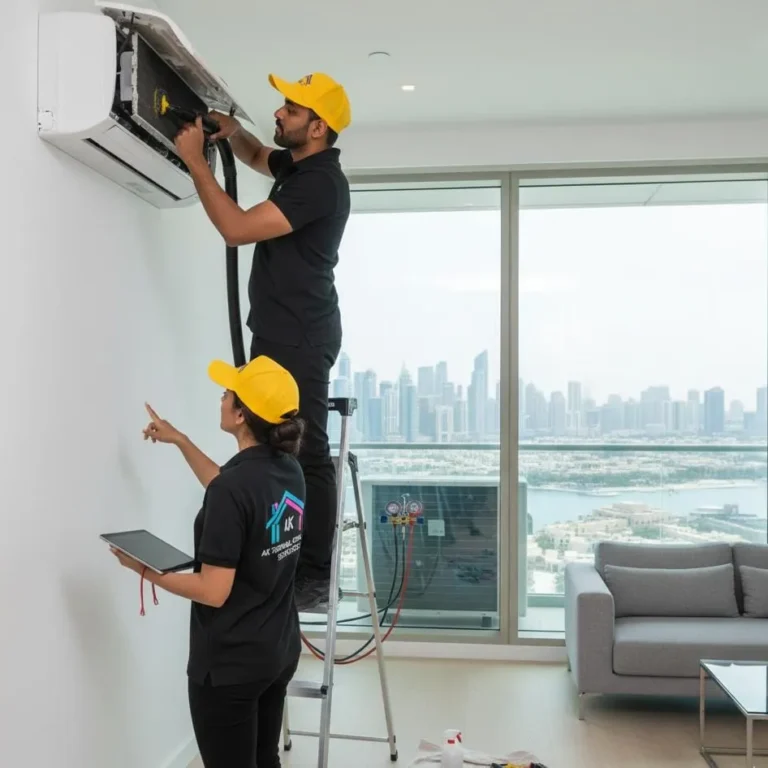
Part Two: Professional Service Checklist (What Good Technicians Actually Do)
This section matters as much as the DIY checklist, maybe more. Because a significant percentage of “professional AC service” in Dubai involves cleaning filters, spraying some water around, and handing you an invoice. Real comprehensive service looks very different.
Here’s what you should expect—and ask about—from professional pre-summer maintenance.
Service Item 1: Deep Coil Cleaning (Both Units)
The indoor evaporator coil and outdoor condenser coil both accumulate grime that filter cleaning doesn’t address. Professional coil cleaning involves:
Indoor coil: Applying coil cleaning foam or spray (Nu-Calgon Coil Bright or similar commercial products) that breaks down accumulated biofilm, mold, and dust that penetrates past the filter. The foam expands through the coil fins and drains through the condensate system. This is not achievable by spraying water—it requires specific chemistry.
Outdoor condenser coil: Washing with water at appropriate pressure to clear dust and debris from between the fins without bending them. In coastal properties, this includes inspecting for and treating salt corrosion with fin coating products.
What to ask: “Do you clean both the evaporator and condenser coils?” If the answer is that outdoor coil cleaning is “extra,” you’re not getting comprehensive service.
Why this matters: A condenser coil with 20% fin blockage from dust operates at significantly elevated head pressure. This stresses the compressor—your most expensive component—and reduces efficiency. I’ve seen condenser coils in Deira apartments that looked like a gray felted blanket on the outside. The unit was operating at 140% of normal head pressure, on its way to compressor failure.
Service Item 2: Refrigerant Pressure Check and Assessment
Here’s where most budget services cut corners.
Checking refrigerant properly requires manifold gauge set and knowledge of what the pressures should indicate for the specific refrigerant type (R32 or R410A in modern units, older units may still have R22) and outdoor ambient temperature at time of testing.
A proper refrigerant check:
- Connects manifold gauges to service ports
- Measures both suction (low-side) and discharge (high-side) pressures
- Compares to manufacturer specifications at current ambient temperature
- Identifies whether any variance indicates refrigerant charge issue, restriction, or other system problem
What it doesn’t mean: Adding gas automatically. This is an important point. Some technicians interpret “refrigerant check” as “add gas and charge you for it.” Refrigerant doesn’t get consumed in normal operation. A system that is genuinely low on refrigerant has a leak. Adding gas without finding and repairing the leak is a temporary fix that will repeat next season.
If a technician says your system needs gas without connecting gauges, that’s a red flag. If they say it needs gas and want to add it without discussing leak detection, that’s another red flag.
Current refrigerant costs (early 2025):
- R410A refill: AED 180-280 per kg depending on quantity needed
- R32 refill: AED 200-320 per kg
- R22 (older units, now restricted): AED 400-600+ per kg due to phase-out
Leak detection cost: AED 150-400 depending on method. Electronic leak detectors are more accurate than soapy water but cost more. For any system that has needed gas two years in a row, insist on electronic leak detection.
Service Item 3: Electrical Component Inspection
A thorough pre-summer service includes electrical checks that most budget services skip entirely.
What should be checked:
- Compressor starting capacitor: Capacitors degrade over time and fail to provide the startup boost the compressor needs. A weak capacitor causes hard starting, which stresses the compressor and shortens its life. Testing requires a capacitor tester or multimeter with capacitance function. Replacement capacitors cost AED 80-200; catching a failing one prevents AED 2,000+ compressor failure.
- Contactor condition: The electrical contactor in the outdoor unit switches power to the compressor and fan motor. Contacts can burn and pit over time, causing overheating and potential failure. Visual inspection reveals obvious wear. Testing under load requires appropriate tools.
- Fan motor ampere draw: Measuring actual ampere draw of both the indoor blower fan and outdoor condenser fan motors and comparing to nameplate rating identifies motors approaching failure. A motor drawing 20% above nameplate rating is working too hard, probably due to bearing wear or capacitor weakness.
- Control board visual inspection: Modern AC systems have electronic control boards. Visual inspection for burn marks, bulging capacitors, or corrosion identifies boards approaching failure.
What this costs to add to a service: A technician who properly performs these checks takes 30-45 additional minutes. Expect to pay AED 50-100 premium over basic service for this thoroughness. Worth it.
Service Item 4: Condensate System Flush and Test
Professional condensate maintenance goes beyond what you can do yourself.
What should happen:
- Clear the drain line from indoor unit to external drain point using air pressure or drain snake if needed
- Flush the drain pan with cleaning solution and water
- Verify drainage rate is adequate (water should drain freely, not slowly)
- Check drain pan condition for cracks or scale buildup that prevents complete drainage
- In some installations, check and clean the condensate pump (properties where drainage runs uphill to an external point use electric pumps that can fail)
Red flag: A technician who doesn’t test condensate drainage after service. Blocked drains are one of the most common causes of water damage in UAE apartments. Verifying the drain works after service takes 5 minutes and prevents significant property damage.
Service Item 5: Outdoor Unit Inspection and Servicing
Beyond coil cleaning, the outdoor unit needs:
Fan blade inspection: Check for cracks, chips, or imbalance in outdoor fan blades. An imbalanced fan vibrates, stresses the motor bearing, and increases noise. Replacement fan blades: AED 100-250 depending on unit.
Refrigerant line insulation: The suction line (larger diameter pipe) connecting indoor and outdoor units must be properly insulated. In UAE’s heat, uninsulated suction lines absorb heat from the environment, reducing system efficiency significantly. Damaged or missing insulation should be replaced. Cost: AED 30-80 per meter depending on pipe size.
Mounting and vibration: Outdoor units should be securely mounted without excessive vibration when operating. Loose mounting screws or deteriorated mounting pads cause vibration that fatigues refrigerant line connections and creates noise complaints. This is particularly common in high-floor installations where vibration transfers through building structure.
Corrosion assessment: In coastal properties, outdoor units need anti-corrosion treatment. Fin Guard or similar products coat aluminum fins to slow salt air attack. Cost: AED 80-150 per unit. Apply annually in coastal areas, every 2-3 years in inland locations.
Service Item 6: System Performance Verification
After all maintenance is complete, verify performance:
- Set system to maximum cooling and run for 15 minutes
- Measure temperature differential between air entering the indoor unit return and air exiting the supply vents. Target: 8-12 degree Celsius temperature drop (also called delta-T). Less than 7 degrees indicates refrigerant or coil issues. More than 13 degrees might indicate restricted airflow.
- Verify outdoor unit is running stable without unusual noise or vibration
- Confirm condensate is draining
What to ask your technician: “Can you show me the delta-T measurement?” A technician who knows this measurement and performs it is working to a professional standard. One who looks confused by the question is not.
The Complete Pre-Summer Checklist: Your Reference Document
Use this as your actual checklist. Print it. Check items off. It works.
DIY Tasks (Complete by April 1):
- Clean or replace all indoor unit filters
- Clean indoor unit louvers and vents
- Clear area around all outdoor units (60cm clearance minimum)
- Check for water stains below or around indoor units
- Run each unit for 30 minutes in cooling mode and document performance
- Replace remote control batteries
- Test all remote control functions
- Check thermostat accuracy if applicable
- Clear visible condensate drain exit points
- Note any unusual noises, vibration, or performance issues
Professional Service Checklist (Complete by April 15):
- Indoor evaporator coil deep clean (foam cleaning agent)
- Outdoor condenser coil wash and inspection
- Refrigerant pressure check with manifold gauges
- Refrigerant leak detection if pressure is low (not just gas top-up)
- Starting capacitor test on compressor and fan motors
- Contactor condition inspection
- Fan motor ampere draw measurement
- Condensate drain flush and flow test
- Drain pan clean and inspect
- Outdoor fan blade inspection
- Refrigerant line insulation check
- Anti-corrosion fin treatment (coastal properties)
- System performance verification (delta-T measurement)
- Written service report documenting findings
Documentation to request:
- Service report with findings for each unit
- Refrigerant pressure readings (actual numbers, not just “OK”)
- Any parts replaced with specifications
- Technician recommendation for any issues found
- Next recommended service date
What Good Pre-Summer Service Should Cost in 2025
Here are realistic cost ranges for Dubai in early 2025. Significant deviation below these ranges means something is being skipped.
Standard split AC service (per unit):
- Basic service (filter clean, coil wash, basic check): AED 150-200
- Comprehensive service (all items in professional checklist above): AED 250-350
- Comprehensive service with minor repairs (capacitor replacement etc.): AED 350-600
Additional services if needed:
- Refrigerant gas top-up (per kg): AED 180-320 depending on type
- Electronic leak detection: AED 150-400
- Condensate pump clean or replace: AED 100-300
- Anti-corrosion fin coating (coastal): AED 80-150 per unit
- Fan blade replacement: AED 100-250 plus labor
- Starting capacitor replacement: AED 80-200 plus labor
Ducted AC system service (different from split):
- Per air handling unit service: AED 400-800
- Per zone damper inspection: AED 50-100
- Duct inspection and cleaning: AED 2,000-8,000+ depending on system size
Package deals for multiple units: Many reputable companies offer packages for properties with 3+ units. Budget AED 200-280 per unit for comprehensive package service versus AED 250-350 per unit individually. For four units, the saving is AED 200-400 on the service alone.
The total budget calculation for a typical 3-bedroom villa (6 AC units):
- Comprehensive service at AED 280/unit package rate: AED 1,680
- Likely minor repairs found during service: AED 400-800
- Any refrigerant top-up needed (maybe 1-2 units): AED 200-500
- Total realistic pre-summer budget: AED 2,280-2,980
Compare this to the emergency scenario: same six units, two fail in June requiring emergency service and repairs: AED 4,000-8,000 depending on what fails.
The math consistently favors preventive maintenance by 30-60% cost savings, plus avoided tenant disruption and relationship damage.
Ducted vs. Split Systems: Where the Checklist Differs
Most UAE apartments have split systems (separate indoor and outdoor units per room or zone). Most larger villas and commercial spaces have ducted systems (centralized air handling units distributing conditioned air through ductwork). The checklist above covers split systems. Here’s what’s different for ducted systems.
Additional ducted system checks:
- Air handling unit (AHU) coil cleaning is more complex—often requires partial disassembly
- Duct condition inspection: UAE duct systems accumulate dust and sometimes mold. Significant dust in ducts reduces air quality and system efficiency. Full duct cleaning is recommended every 3-5 years for occupied villas.
- Zone damper operation: Motorized dampers that control airflow to different zones can stick or fail. Testing each zone ensures balanced cooling distribution.
- Drain pan condition: Ducted AHUs have larger drain pans and more complex drainage that requires specific attention.
Cost difference: Ducted system service is more expensive due to access complexity and system size. Budget AED 400-800 per AHU for comprehensive service.
Who services ducted systems: Not every AC company that services residential splits is qualified for ducted systems. Ask specifically about their ducted system experience and request examples of similar properties they service.
The Parts Most Likely to Fail During Your First Hot Summer: What to Watch For
If you own a property with AC systems aged 6-10 years, these components have the highest summer failure probability. Your technician should specifically assess these during pre-summer service.
Compressor starting capacitors (7-12 year failure peak): Every compressor motor has a capacitor that provides the electrical surge needed to start the motor. Capacitors degrade predictably over time. A failing capacitor causes hard starting (the compressor makes a clicking sound, then a grinding start, instead of a smooth startup sound). Replacement: AED 80-200. Avoiding this: prevents compressor damage worth AED 1,500-4,000.
Contactor (8-12 year failure peak): The high-current switch that sends power to the compressor and fan. Pitted or welded contacts cause overheating and complete failure. Signs: visible pitting or burn marks on contacts. Replacement: AED 100-250.
Fan motor bearings (8-15 year failure): Both indoor blower fan and outdoor condenser fan motors have bearings that wear over time. A grinding or squealing noise from the fan indicates bearing wear. Running to failure destroys the motor. Replacement: AED 300-800 depending on unit.
Expansion valve (10-15 year failure): Controls refrigerant flow from high-pressure to low-pressure side. A failing expansion valve causes either inefficient cooling or system shutdown. More expensive repair: AED 600-1,500 including labor.
Why knowing this matters: If your pre-summer inspection reveals any of these components showing wear, repairing now (cheaper, planned, available parts) is dramatically better than emergency repair in July (expensive, urgent, potentially waiting days for parts).
Common Mistakes That Guarantee Summer AC Problems
These aren’t hypothetical. I’ve seen each of these create predictable failures.
Mistake 1: Servicing only the “main” AC and skipping guest rooms
Every AC unit in your property needs pre-summer service. Skipping guest room units because “nobody uses them much” is exactly backwards. Infrequently used units often have worse dust accumulation because they run in bursts rather than continuously clearing dust from filters. Guest room units that fail when you have visitors are spectacularly inconvenient.
Mistake 2: Accepting “the system was checked” without a written report
A verbal assurance that everything is fine has zero value when something fails three weeks later. Every professional service should produce a written report documenting what was checked, findings, any repairs made, and technician observations. If a company doesn’t provide this, find one that does.
Mistake 3: Buying service contracts without reading what’s included
Annual AC maintenance contracts sound reassuring. They vary enormously in what’s actually included. Some contracts cover labor only, not refrigerant or parts. Some cover one service per year, not the quarterly service high-usage UAE systems benefit from. Read the contract. Know specifically what’s included for the annual fee.
Mistake 4: Delaying service because “it’s still cool”
April 15 feels cool enough. May feels manageable. By late May, every technician in the city is booked 2-3 weeks ahead. The best companies stop taking new clients for the season. The options remaining are either substandard companies or companies charging premium emergency rates. The “we still have time” logic costs money every year.
Mistake 5: Confusing cleaning with servicing
Many cheap service offerings are essentially cleaning: filter cleaning, maybe a quick coil spray, invoice issued. This isn’t nothing, but it’s not the professional service your system needs before summer. Cleaning doesn’t check refrigerant pressure, test capacitors, assess motor condition, or verify performance after service. Cleaning for AED 80 per unit feels like a bargain. It’s a bargain that might cost you AED 3,000 in July.
Mistake 6: Forgetting outdoor unit access
In high-floor apartments, outdoor units might be accessible only from outside the balcony railing—requiring rope access or scaffolding. Some buildings require advance booking for access equipment. Arrange this during pre-season when scheduling is flexible. Trying to arrange outdoor unit access during an emergency in July adds days to an already frustrating situation.
What’s your current AC maintenance situation? Are you booked for pre-summer service, or have you been in the “I’ll get to it” category? Share your experience below—and if you’ve had a summer AC failure story, tell us what it actually cost you. Those numbers help everyone make better decisions.
Need professional pre-summer AC maintenance across Dubai? Our DEWA-registered technicians serve JVC, Business Bay, Dubai Marina, Al Barsha, Deira, and all major communities with transparent pricing and written service reports. Book your service before the April rush—contact us for availability.
For most residential properties, twice yearly is the minimum: once before summer (February-April) and once at summer's end (October-November). High-use units in properties with heavy dust exposure or coastal locations benefit from quarterly service. Ducted systems in villas should receive at least quarterly filter changes and twice-yearly comprehensive service. For tenant-occupied rentals, I recommend three services annually to maintain tenant satisfaction and reduce emergency call frequency.
For accessible indoor unit filters and the easily reachable parts of the evaporator coil, some supermarket foam cleaners (Sanyo, generic brands, AED 15-30 per can) work reasonably well for light maintenance cleaning. They don't replace professional service because they don't reach deep into the coil, don't address refrigerant or electrical components, and aren't always appropriate for all coil types. Use them for monthly maintenance between professional services, not as a replacement for annual professional service.
Yes, though with less urgency for failure risk. New units don't need capacitor or motor replacement, but they absolutely benefit from coil cleaning, refrigerant verification, and condensate drain clearing. Dubai's dust and hard water affect new systems as aggressively as old ones. A 2-year-old unit with a blocked condenser coil runs inefficiently and builds unnecessary stress on the compressor. Annual service from the beginning extends total system life and maintains efficiency.
Temporary measures: Use portable AC units (rental from equipment companies, AED 80-150 per day) for the most critical rooms. Maximize natural ventilation during cooler night hours. Use ceiling fans and portable fans to redistribute existing cooling. Close blinds and curtains to reduce solar heat gain. Move activity to lower floors where possible (heat rises). For tenants, the landlord's obligation to provide habitable conditions means urgent repair is legally required—document the situation in writing.
DEWA registration specifically covers electrical connections to AC systems. Verify on dewa.gov.ae using the company's registration number. For refrigerant handling, ask whether technicians are certified in refrigerant handling—UAE follows similar requirements to European F-Gas regulations regarding who can handle and recharge refrigerants. A reputable company will readily provide documentation. One that hedges or can't provide registration information warrants caution.
The failure scenario follows a predictable pattern: gradual decline in cooling performance (often noticed by tenant before landlord), followed by eventual breakdown under peak summer load. Repair costs average 3-4 times preventive service cost for the same issues. Emergency service adds premium fees. Tenant complaints and potential RERA claims add stress and sometimes cost. In the worst cases—particularly condensate drain failures causing water damage to ceilings and flooring—total cost can reach AED 10,000-30,000 for a single unit failure cascade in a high-floor apartment. I've seen this happen. The maintenance that would have prevented it cost AED 300.